
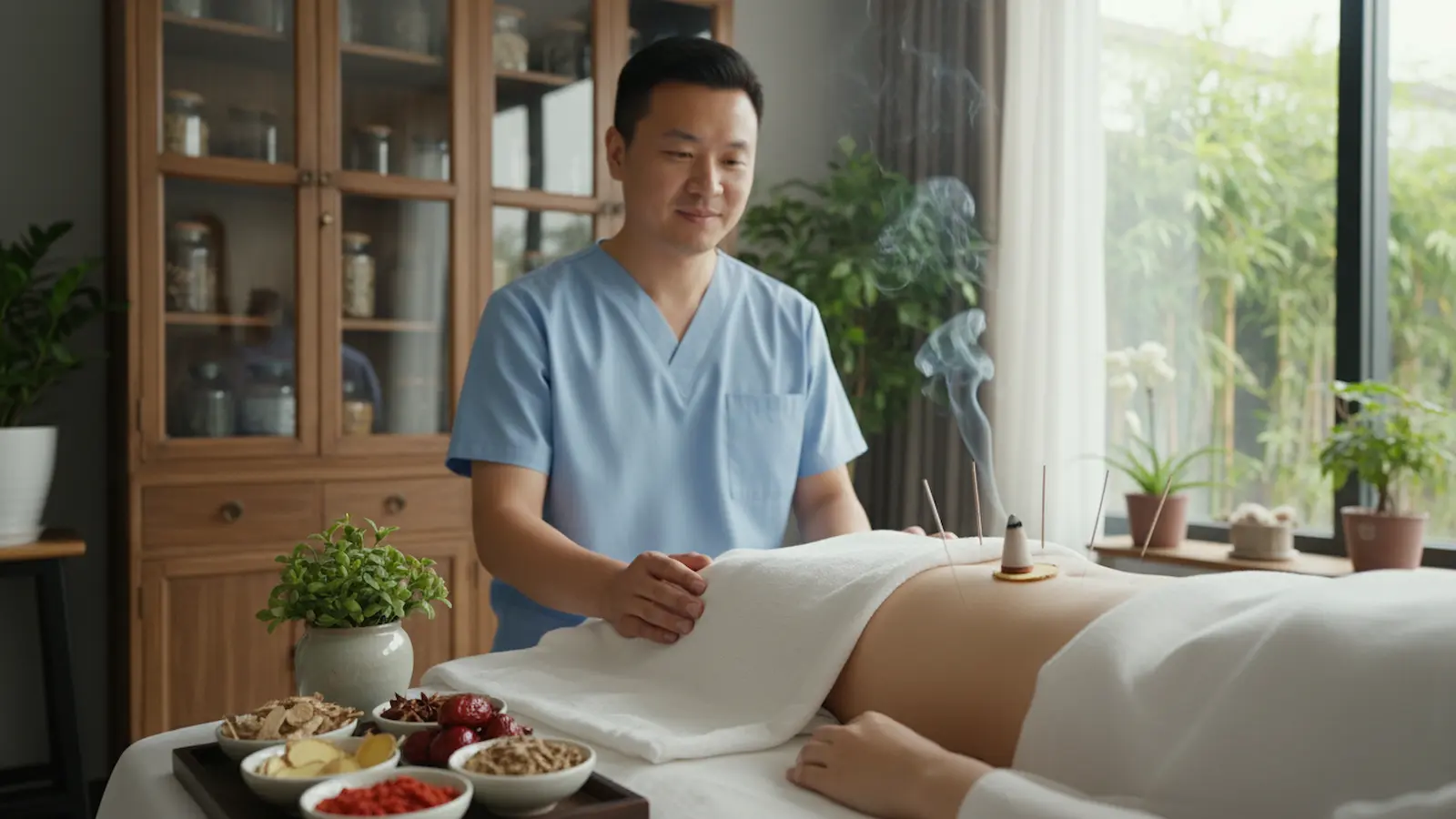
Quick answer: In Traditional Chinese Medicine, bloating is usually read as a sign of Qi stagnation, Spleen deficiency, or dampness affecting digestion, rather than a single disease. Treatment with acupuncture, custom herbal formulas, and dietary adjustment aims to restore the Spleen and Stomach's ability to move food and fluids smoothly. Most people plan on several visits to see how their body responds.
Bloating Chinese medicine theory treats as a symptom with several possible roots, not as one fixed diagnosis to be matched against a single remedy. Two people with the same complaint of a tight, distended abdomen after meals can walk away with entirely different formulas and acupuncture points, because the underlying pattern driving the bloating is different in each case. This is one of the reasons a proper diagnosis matters so much before any treatment begins.
In this article
- Understanding Bloating Through a Traditional Chinese Medicine Lens
- Common Patterns Behind Bloating
- How Treatment Works
- What to Expect During a Visit
- Diet and Lifestyle Alongside Treatment
- Why Traditional Healing Centre Fits Here
- When Bloating Needs a Doctor's Attention
- In this series
Understanding Bloating Through a Traditional Chinese Medicine Lens
In Traditional Chinese Medicine, digestion is described in terms of Qi, the body's functional energy, and how well it moves through the Spleen and Stomach. When that movement slows down or gets blocked, fluids and food can sit where they shouldn't, and bloating is often the result.
Why the Same Symptom Can Have Different Patterns
A lot of questions about your digestion, your stress levels, your sleep, and your health in general, then a look at your tongue and a reading of your pulse, help work out which pattern is at play. This is how Traditional Chinese Medicine distinguishes bloating caused by weak digestion from bloating caused by emotional tension or by food that simply hasn't moved through properly.
Common Patterns Behind Bloating
Spleen Qi Deficiency
When the Spleen's Qi is weak, it struggles to transform food into usable energy and to move fluids efficiently. This often shows up as bloating that worsens after eating, along with fatigue, loose stools, or a feeling of heaviness.
Liver Qi Stagnation
Stress and frustration can cause the Liver's Qi to stagnate, which in turn interferes with the Spleen and Stomach's ability to digest smoothly. Bloating linked to this pattern often comes with tightness in the ribs or abdomen and tends to shift with mood or tension.
Dampness and Food Stagnation
Dampness, often from diet, environment, or an already weakened Spleen, can accumulate and create a heavy, swollen sensation. Food stagnation, where undigested food lingers in the Stomach, produces a similar fullness, sometimes with belching or a sour taste.
How Treatment Works
Acupuncture for Digestive Qi
Acupuncture points are chosen to support the Spleen and Stomach's Qi and to encourage Liver Qi to flow more freely. The specific points used depend entirely on which pattern the diagnosis points to.
Herbal Formulas
A formula written for digestive complaints is built from the individual's pattern rather than pulled from a standard list. Herbs that strengthen the Spleen, move Qi, or resolve dampness may all play a role, often combined in a single custom formula. For related reading on how herbs support the body's Blood and overall function, see Blood-Building Herbs in Chinese Medicine.
Tuina Massage and Other Supports
Tuina massage, Chinese cupping, and moxibustion are sometimes added alongside acupuncture and herbs to support Qi movement and warm the digestive system, depending on what the diagnosis calls for.
What to Expect During a Visit
Every visit starts with a full diagnosis. I ask a lot of questions, look at your tongue, and take your pulse, then work out why you are experiencing bloating, not just that you have it. From there, a course of treatment is planned, and most patients plan on five to ten visits before judging how well things are progressing. Bloating connected to bowel patterns is also worth reading about separately; see Constipation Chinese Medicine: A TCM Approach for more on that overlap.
Diet and Lifestyle Alongside Treatment
Regular meal timing, thorough chewing, and avoiding excess cold or greasy foods are commonly recommended alongside treatment, since these habits support the Spleen's work rather than adding to its burden. Managing stress also matters where Liver Qi stagnation is part of the picture, since ongoing tension can undo some of the progress made in treatment.
Why Traditional Healing Centre Fits Here
At Traditional Healing Centre in Keswick, Ontario, every treatment plan starts from your own Traditional Chinese Medicine diagnosis, never an off-the-shelf protocol. Jason Tarter, R.TCMP, R.Ac, has been in practice for 18 years, combining acupuncture with custom herbal formulas written for the individual patient and filled through the clinic's own herbal dispensary. Jason is registered with the College of Traditional Chinese Medicine Practitioners and Acupuncturists of Ontario (CTCMPAO), and receipts are issued by a Registered Acupuncturist and Registered Traditional Chinese Medicine Practitioner, which many extended health plans accept for acupuncture and Chinese medicine services, though OHIP does not cover these treatments. For a broader look at what these treatments can address, visit Chinese Medicine Benefits: What Acupuncture and Herbs Can Do.
When Bloating Needs a Doctor's Attention
Occasional bloating after a heavy meal is common, but bloating that is persistent, severe, or paired with unexplained weight loss, blood in the stool, or significant pain deserves a medical evaluation. Traditional Chinese Medicine can work well as a complementary approach alongside that care.
If bloating has been a recurring part of your life, a proper diagnosis is the place to start. Book an appointment with Traditional Healing Centre to talk through your symptoms and find out what pattern may be behind them.
In this series
- Bloating Chinese Medicine: Causes and Natural Relief
- Chinese Medicine Liver Diet: Foods That Support Liver Qi
- Constipation Chinese Medicine: A TCM Approach