
Conditions · Pain
Acupuncture for Shoulder Pain (Rotator Cuff & Impingement)
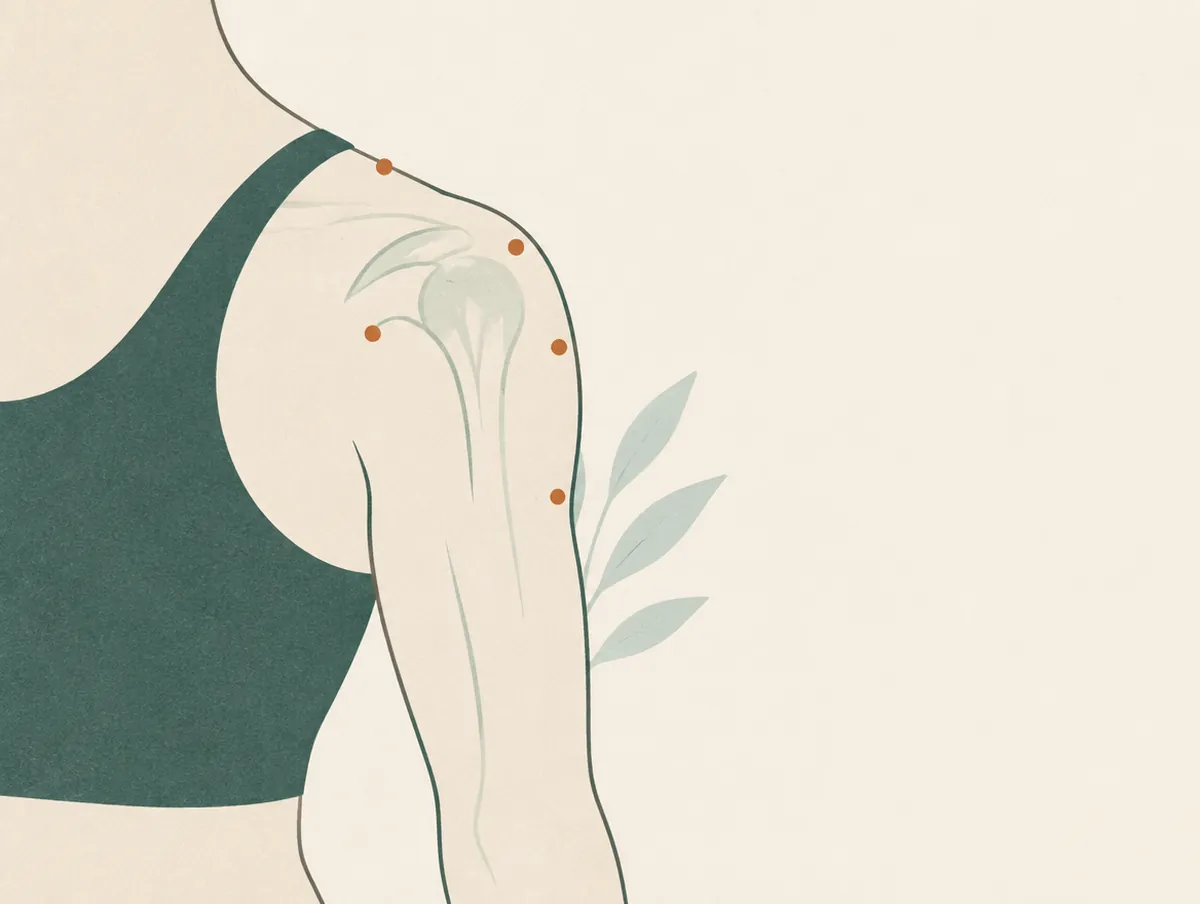
Rotator cuff strain and impingement cause a sore shoulder that hurts when you lift or reach, while the joint itself still moves. We use acupuncture and related treatments to ease pain and support movement, based on a Chinese medicine diagnosis.
Common symptoms
- Pain at the top or outer side of the shoulder, sometimes spreading toward the elbow
- A painful arc: it hurts to lift the arm between waist and shoulder height
- Pain reaching overhead, behind your back or into a back seat
- Night pain, especially lying on the sore side
- Weakness when you lift or turn the arm out
Common causes
- Irritation or wear of the rotator cuff tendons (rotator cuff tendinopathy)
- The tendons and bursa being pinched under the top of the shoulder blade when you lift the arm (impingement)
- Repeated overhead work or sport, such as painting, drywall, swimming or throwing
- A partial or full tear of a rotator cuff tendon, from a fall or from wear with age
- Rounded posture that narrows the space above the joint
How Chinese medicine understands shoulder pain
A sore rotator cuff or an impingement is, in Chinese medicine, a problem of the channels that cross the shoulder. Several channels run over the top and back of the joint, and where the pain sits tells the practitioner which ones are involved. Pain at the front of the shoulder, at the outer point, and across the shoulder blade are treated differently.
Like most joint pain, it is usually seen as a kind of Bi syndrome: Qi and Blood not flowing freely through the area. The common patterns are:
- Qi and Blood stagnation from strain. Sharp, fixed pain that follows overuse, a heavy lift or a fall. It hurts at one spot and is worse with the movement that caused it.
- Wind, Cold and Damp. An ache that is worse in cold, damp weather or after sitting in a draft, and eases with heat.
- Deficiency of Qi and Blood. A dull, tired ache with weakness in the arm, slow healing, and often poor energy in general. In Chinese medicine the tendons are seen as not being well nourished.
The pattern decides what the treatment focuses on: moving circulation through a strained area, warming a cold one, or building up a weak one. Many people have a mix.
What treatment involves
Your first visit at the clinic in Keswick takes 75 minutes and includes the diagnosis and your first treatment. Expect a lot of questions: how the pain started, which movements set it off, your work and sport, your sleep. I also look at your tongue and take your pulse. An assessment usually includes checking which arm movements hurt and how far the shoulder moves, so there is a baseline to compare against. Follow-up visits are 60 minutes.
Acupuncture is the main treatment. Points are commonly chosen around the shoulder along the painful channel, and also in the arm, the neck and further away on the body. I treat the whole body at every treatment, not only the area that hurts. Tight neck and upper back muscles often come along with a sore shoulder, and those get treated too.
Cupping and tuina massage can help loosen the muscles over the shoulder blade and upper back. For a pattern that is worse with cold, moxibustion adds warmth. When the pattern calls for it, Chinese herbal medicine is a formula written for you and dispensed at the clinic.
Treatment fits alongside physiotherapy and a strengthening program. Plan on 5–10 treatments to judge progress. If your shoulder moves very little at all, the frozen shoulder page may fit your situation better.
Between visits
- Keep the shoulder moving within comfort. Do your physiotherapy or strengthening exercises regularly. Stop short of sharp pain.
- Change how you reach. Bring the work closer, use a step stool for high shelves, and keep your elbow below shoulder height when you can.
- Watch your posture at a desk or phone. Rounded shoulders narrow the space the tendons pass through.
- Sleep on the other side, with a pillow to hug so the sore arm does not fall forward.
- Ease back into sport. Build up throwing, swimming or racquet work gradually after a flare.
When to see your doctor first
See your doctor before starting treatment, or promptly if you are already coming in, if:
- The pain began with a fall or injury, or you suddenly cannot lift the arm. A tear or fracture needs to be ruled out.
- The shoulder looks deformed, or you felt it pop out of place.
- You have fever, redness, heat or marked swelling around the joint.
- Left shoulder or arm pain comes with chest pain, shortness of breath, sweating or nausea. Call 911.
- Numbness, tingling or weakness runs down the arm, which can come from the neck.
- The pain is constant, not affected by movement, or comes with weight loss you cannot explain.
Questions about shoulder pain (rotator cuff & impingement)
How is this different from frozen shoulder?
With rotator cuff pain or impingement, the shoulder hurts to use, but someone else can usually lift your arm through its full range. With frozen shoulder, the joint capsule tightens and the arm will not go further even when someone moves it for you. The two need different plans, so a doctor's or physiotherapist's assessment helps.
Can I keep working or training while I have treatment?
Usually, with changes. Cut back on the overhead or repeated movements that set the pain off, and keep up the exercises your physiotherapist gave you. Complete rest tends to leave the shoulder weaker.
Do I need an ultrasound or MRI first?
Not always. If the pain started with a fall or injury, or you cannot lift the arm at all, see your doctor first, because a tear needs to be ruled out. For gradual pain from overuse, imaging is up to your doctor.
Related conditions
- Achilles Tendinitis
- Ankle Sprain
- Back Pain
- Bursitis
- Carpal Tunnel Syndrome
- Fibromyalgia
- Frozen Shoulder
- Golfer's Elbow
- Gout
- Headaches & Migraines
- Hip Pain
- Knee Pain
- Neck Pain
- Osteoarthritis
- Peripheral Neuropathy (Numbness & Tingling)
- Piriformis Syndrome
- Plantar Fasciitis
- Repetitive Strain Injury
- Rheumatoid Arthritis
- Sciatica
- Shin Splints
- Sports Injuries
- Tennis Elbow
- Trigger Finger
- Upper Back Pain
- Whiplash
- Wrist Pain & Tendinitis